How to Fix Knitting Mistakes
Reviewing your knitting, solving the mystery of what went wrong, and the right fix for each mistake.
Quick fixes on video:
When mistakes happen
Since our hands are not machines, mistakes are an inevitable part of knitting. Although they are frustrating, with the proper tools you can learn how to recover quickly. If you are new to knitting, mistakes will happen more often, and that is part of the learning process! There is a saying I heard once about perfection in handcrafts: you cannot make something perfect because it would offend the gods. Indeed, the slight imperfections are what make things "handmade".
For those who strive for perfection anyway, you will find guidance here on how to fix common mistakes, as well as explanations of how these mistakes happen.
What did I do? Reviewing your knitting
Is it worth fixing?
The #1 rule of knitting mistakes, called "the Prancing Pony", asks: if you were holding your knitting while riding a prancing pony, would someone be able to see the mistake? If not, it is not worth fixing!
Evaluating the mistake
One way to identify an error is to know what you were trying to do.
It also depends on when you come across your error. On the next row? After several rows? After several inches?
Mistakes in ribbing, such as knitting a stitch you should have purled, are easily fixed if you discover them on the next row. See how to fix a knit instead of a purl.
Solving the mystery: what does it look like?
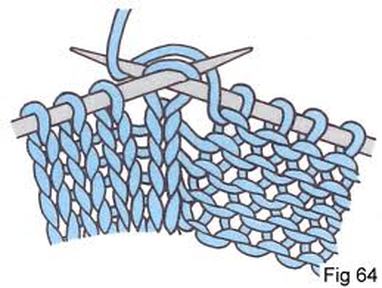
Is there a loose stitch?
A single dropped stitch looks like a small loop that is not on your needle.
If the stitch has dropped further, there may be bars going across and a large hole forming.
Is there a hole?
You may have accidentally done lace knitting!
This could be a dropped stitch that you "rescued" on a later row, so there is no loose stitch.
Check out the videos for fixing dropped stitches with knitting needles or with a crochet hook.
Is there an extra stitch?
When extra stitches form accidentally, the number of stitches in the row increases when you didn't mean it to.
Accidental increases can come from extra yarn overs (yo), caused by the yarn being in front while knitting or in back while purling. Check out the videos for fixing an accidental yarn over and an incomplete stitch.
Is it hard to knit into?
You may be wrapping in the wrong direction, causing your stitches to become twisted.
If the stitches get tighter as you keep knitting, you might be knitting into the back of the stitch (rather than the front), twisting your stitches.
You may also have dropped the needle out of your stitches and put them back on the needle the wrong way.
Check out the video for fixing twisted stitches.